


Human interactions and relationships are complex. How can we make sure that we are holding the right conversations? At the heart of most conflict is a breakdown of communication. Two great books I’ve recently read, and highly recommend, are:
- Crucial Conversations: tools for talking when stakes are high; and
- Nonviolent Communication: a language of life.
These books are both powerful resources for improving communication in high-stakes, emotionally charged situations. While both focus on fostering constructive dialogue, they come from slightly different perspectives. Crucial Conversations is more focused on navigating high-stakes or emotionally charged situations, while Nonviolent Communication emphasizes a foundational approach to communication that fosters empathy and mutual respect in all interactions. If you’re interested in exploring (and challenging) your communication style, the two different approaches can be summarised below:
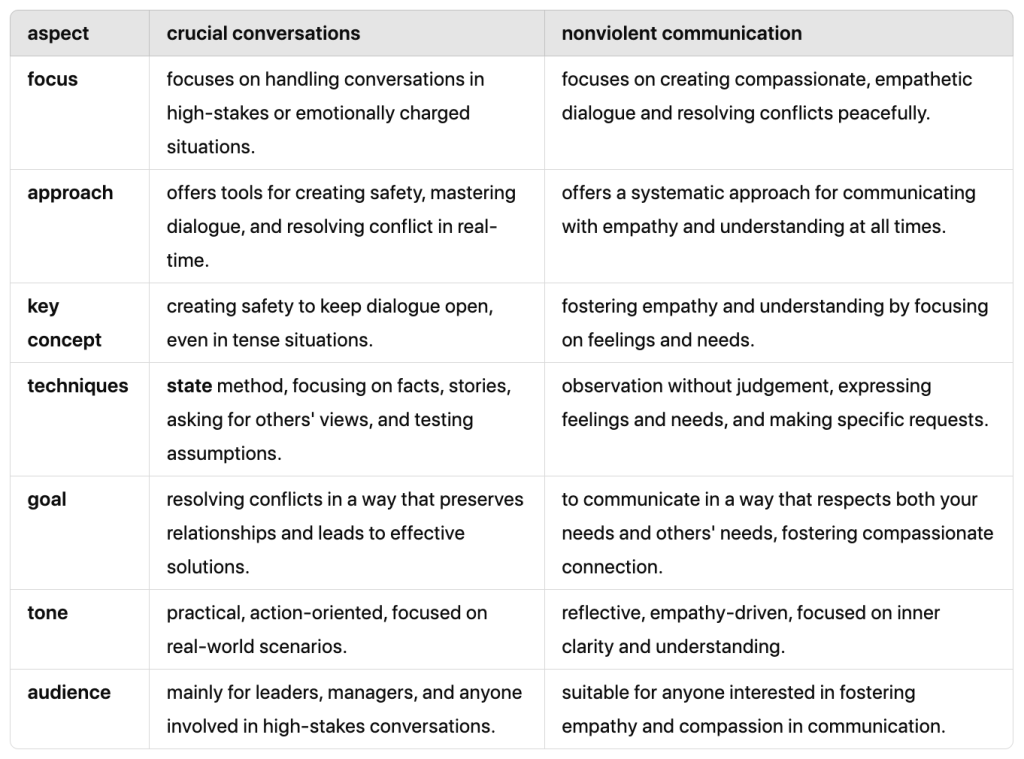
Having crucial conversations
Crucial Conversations emphasizes real-time action in high-pressure situations where both parties might be emotionally charged. It provides tools to keep the conversation productive, even when emotions are high and stakes are significant. The tools suggested are ideal when you are facing a difficult or high-stakes conversation (such as addressing a performance issue at work, or resolving family disputes). It helps you maintain control of the situation, avoid escalation, and reach a productive outcome.
The authors emphasise that for a conversation to be productive, participants need to feel safe. If people feel threatened, they’ll either shut down or become defensive, which derails the conversation. Successful crucial conversations involve mastering the skill of open dialogue, where participants share their perspectives without fear of judgment or retaliation.
Tools and techniques include:
- Start with heart: focus on what you really want to achieve from the conversation. Are you seeking to understand, find a mutual solution, or preserve the relationship? Keeping this in mind helps you stay grounded and avoid escalating conflict.
- Learn to look: pay attention to both verbal and non-verbal cues. If someone becomes defensive, shuts down, or starts to argue, it’s a sign that the conversation is crossing into unsafe territory.
- Make it safe: acknowledge the other person’s perspective and concerns. This can involve using affirmations, asking for their opinion, and showing that you care about their feelings.
- Master your stories: recognise the stories that you’re telling yourself about the situation. These are the assumptions, judgments, and interpretations that influence your emotions.
- STATE my path framework for speaking your truth without accusation:
- share your facts
- tell your story
- ask for others’ opinions
- test your assumptions
- explore their views
- Agree, build, and compare: When resolving a disagreement, start by agreeing on areas of consensus, build on common ground, and only then discuss the differences.
Actions include being able to recognise when a conversation becomes crucial and requires a deliberate approach, creating safety to ensure both sides feel heard and respected, use of the STATE framework to express your perspective clearly and assertively, and avoiding the ‘silence or violence’ response (shutting down or attacking) to instead engage in open, respectful dialogue.
Nonviolent Communication
Nonviolent Communication (NVC) takes a deeper, more reflective approach. It’s more about changing the underlying mindset around communication, teaching individuals to express themselves and listen in a way that minimises conflict and promotes understanding, empathy, and connection. Developed by Marshall Rosenberg, NVC is a method for communication that emphasises empathy, compassion, and understanding. The goal is to express needs and feelings without judgment or criticism and to foster mutual respect and understanding. NVC revolves around four components:
- Observation: focus on observing the situation without judgment – avoid evaluating, labeling, or criticising.
- Feelings: identify and express your own feelings – these are your emotional responses to the situation, not thoughts or interpretations.
- Needs: recognise the underlying needs or values that are driving your feelings. Needs are universal and often hidden behind emotions.
- Request: clearly and respectfully ask for a specific action or behaviour that would address your needs.
Tools and techniques include:
- Observation without evaluation: instead of judging or blaming, observe facts as objectively as possible – eg instead of saying “you never listen to me,” try “when I spoke earlier, you were looking at your phone.”
- Expressing feelings: identify and express emotions accurately – eg instead of saying “I’m upset,” you might say “I feel frustrated” or “I feel ignored.” This prevents others from feeling defensive or blamed.
- Identifying needs: this involves going deeper to understand what needs are not being met – things like respect, understanding, connection, and autonomy.
- Making requests: these should be clear, positive, and actionable. They should also leave room for the other person to express their needs.
- Empathy: active listening and empathy play a key role – you’re encouraged to listen deeply and reflect the other person’s feelings and needs to show understanding.
Actions include identifying and separating observations from evaluations, expressing your feelings without blame or criticism, identifying and expressing your underlying need, making specific, respectful requests to meet those needs, and listening with empathy.
New year, clear communications
As we move into the New Year, explore the tools and techniques that will help you to become a more effective communicator.



You must be logged in to post a comment.